
Break Out of the Box: String Skipping with the A Minor Pentatonic Scale
If you’ve been playing the pentatonic scale for a while, you’ve probably fallen into the familiar up-and-down pattern. It’s comfortable, it works for a lot of music, but it can also start to sound repetitive.
One of my favorite ways to make pentatonic lines more exciting (and to challenge your fingers) is String Skipping. It’s exactly what it sounds like: instead of playing every string in order, you “jump over” one or more strings to create bigger intervals, more dynamic phrasing, and a more vocal-like melody.
This approach can:
-
Break you out of muscle memory patterns
-
Improve dexterity and accuracy
-
Add more interest to your solos
-
Help you navigate the fretboard more creatively
The Scale We’ll Use: A Minor Pentatonic
The A minor pentatonic scale has no sharps or flats and is a staple for blues, rock, and many other styles. In its first position, it looks like this:

The String Skipping Exercise 1: A Minor Pentatonic
Here is the tab for the String Skipping Exercise using the A Minor Pentatonic Scale:
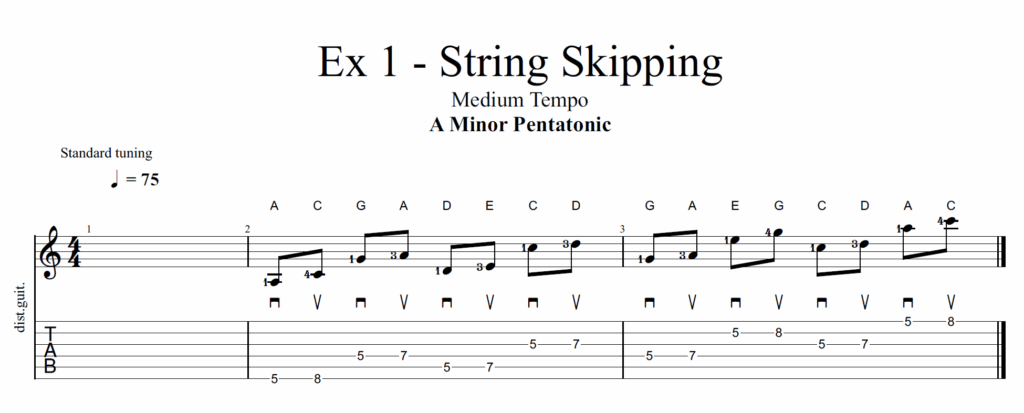
Here’s how we’ll turn that box into something more interesting:
-
Start on the low E string, 5th fret (A), then 8th fret (C)
-
Skip the A string and go to the D string, 5th fret (G), then 7th fret (A)
-
Back to the A string, 5th fret (D), then 7th fret (E)
-
Skip to the G string, 5th fret (C), then 7th fret (D)
-
Play the D string again, then skip to the B string, 5th fret (E), then 8th fret (G)
-
Play the G string again, then skip to the high E string, 5th fret (A), then 8th fret (C)
This constant jumping between non-adjacent strings forces you to think ahead, stay accurate with your picking, and break the “straight up, straight down” habit.
Picking Tips
-
Use alternate picking for efficiency (down-up-down-up)
-
Think about where your pick needs to “land” after each skip, don’t let your picking hand wander
-
Keep fretting hand fingers assigned to one fret each in this position (index on 5th fret, pinky on 8th, etc.)
Watch The Video Lesson and Play Along With Me
I’ve recorded a play-along demonstration at 75 BPM so you can practice it with me. Once you’ve got it down, try the faster and slower tempos so you can push your speed and control.
[embedyt] https://www.youtube.com/watch?v=OvmPozNgT14[/embedyt]
Play With The Example
[embedyt] https://www.youtube.com/watch?v=-CZIV6lo3jY[/embedyt]Next Level Challenges
-
Move the entire pattern to a different key by shifting your starting fret
-
Reverse the pattern (start high and move down) for more variety
-
Combine string skipping with bends, slides, or hammer-ons/pull-offs
-
Use it in an actual solo and improvise over a backing track and drop it in
Takeaway: String skipping isn’t just a “flashy” technique, it’s a great way to inject life into your solos, train your coordination, and make even a familiar scale feel new again.