The Major Scale. Why this is the one to learn.
If you learn one scale properly, make it the major scale.
C Major first, then move the same shapes to G major and E natural minor.
Everything else hangs off it.
Pentatonics, modes, chord tones, harmony, the lot.
You’ve probably learned the A minor pentatonic, and that’s a really useful scale. The C Major scale even has some common notes with the A minor Pentatonic.
If you’ve been struggling to know where to go next, then the C Major scale is just that.
On this page, I share some great fretboard patterns to get you started with this important scale.
Why start with C major.
- No sharps, flats or other confusing naming conventions.
- It lets your hear the pure interval recipe as a great foundation to the core scale in music.
- Once you can play and hear the C major, you can use this as a reference to move around the fretboard.
Quick tip | Interval recipe:
The most important thing to understand when thinking about any scale is the musical space, intervals, between the notes. I think of these in terms of tones and semitones, which relate to frets very simply and moving one fret is a semitone and two frets is a tone.
C Major Interval Recipe:
From a starting point, the root note, C we can then move up in pitch using a recognizable scale recipe or pattern, in terms of tone and semitones gaps/intervals between the notes.
The interval recipe is tone | tone | semitone | tone | tone | tone | semitone.
You can also work back from the root note and descend down that pattern but in reverse.
For C Major, the beauty of this is that the notes are simple and pure alphabetic related, with the notes being C, D, E, F, G, A, B, C.
Here is the chromatic scale with C Major scale notes indicated:
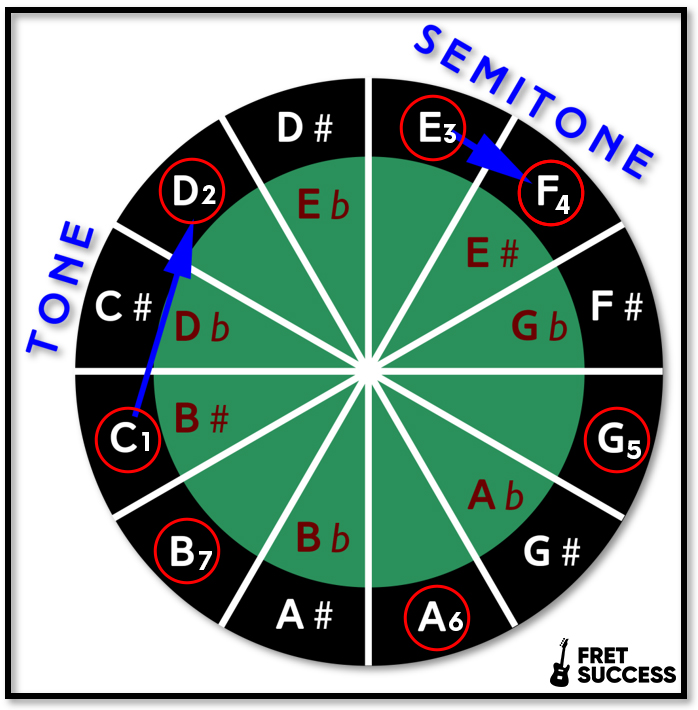
Ascending in the alphabet from C to the highest natural note we can play in music is G, and then we start at the beginning of the alphabet again and finish off.
How we’ll map it today.
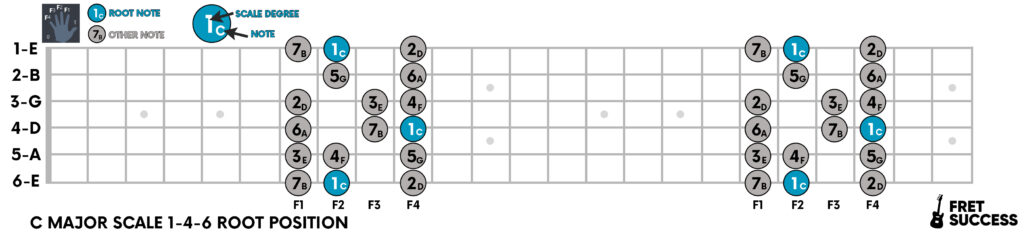
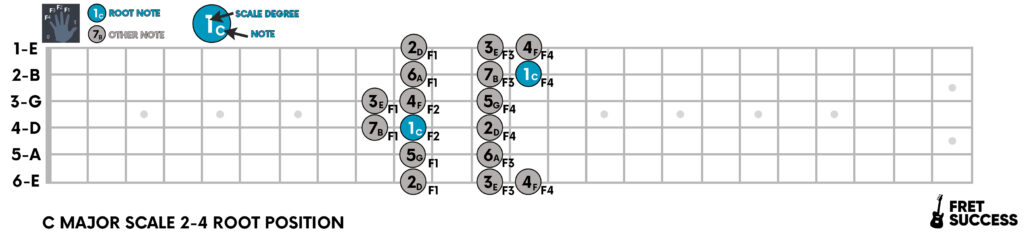
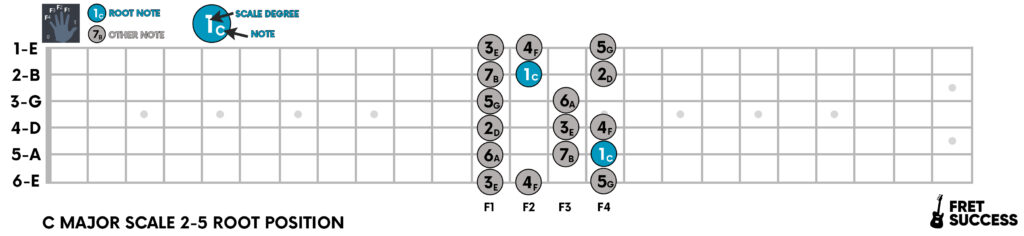
You will see three shapes on the fretboard diagrams at the bottom of this email. They’re also given on my website here, which may be easier viewing for you.
Each one shows the scale with the root note highlighter and suggested fingering. We’ll reference them the following way, so you can easily know which one you’re playing.
- C Major. Root 1-4-6
Roots on strings 1, 4, and 6. This is your “big picture” map. - C Major. Root 2-4
Roots on strings 2 and 4 - C Major. Root 2-5
Roots on strings 2 and 5
Use the fingerings on the diagrams, indicated by F1, F2, F3, and F4.
There are some other fingerings we could play but these require some bigger finger stretches.
Why this matters.
The major scale is the reference map. Chords are built from it. Modes are views of it.
When you really hear it, every song gets easier to decode and every solo idea lands cleaner. If you learn one scale well, it’s this one.
How to actually learn this.
Noodling is fun, we all do it but work through this instead.
Phase 1. Hear the intervals.
- Sing, or even just speak the letters C, D, E, F, G, A, B, C while you play.
- Really focus on the 3 and 7 so your ear learns those semitone changes after those notes.
- Set a loop going with a C note playing or just a backing track going in C Major and then play through the scale shapes and listen to how each note fits over it. This will help you start to know how each note sounds against the chord, which contains notes 1, 3, and 5 of the C Major scale.
Phase 2. Feel it.
- Play the scale shapes in quarter, eighth, sixteenth and maybe even triplet rhythms at the same tempo.
- You could also try accenting beat 2 and 4 while you climb. This helps you build feel and not just finger positions. Try using a mix of alternate picking and legato hammer on and pull offs.
Phase 3. Make Music.
- Try using only three notes. First restrict to a melody using C, E, and G. Then switch to using D, F, and A.
- Move the same three-note idea through your three diagrams. Same idea. Different spot. That will help you open up ideas and improve your feel across the fretboard.
Common Traps. Quick Fixes.
- Trap 1: Treating the shapes like steps on a ladder.
Fix: play in thirds. C-E, D-F, E-G. Then sixths. C-A, D-B, E-C. It sounds more musical and less like a piano recital. Playing through the patterns, sequentially note by note is a good start to get them in your head, but don’t focus on that each time. Be intentional with note selection. - Trap 2: Playing fast and sloppy.
Fix: Set the tempo of your metronome or beat to something you can easily play in time and only increase tempo when you can really grove in the current one you’re working on. Speed is fun but being musical and rhythmically interesting is more important. Try singing back your solos, to get a feel for good phrasing and tempo. - Trap 3: Playing one key.
Fix: After a week in C Major, shift the same diagrams to G Major. This is a fantastic key for guitar, which you can also play over E minor chords.
A teeny tiny practice plan.
- 2 min. Diagram 1 – Root 1-4-6. Thick to thin strings. Top to bottom.
- 2 min. Diagram 2 – Root 2-4. Thick to thin strings. Top to bottom.
- 2 min. Diagram 3 – Root 2-5. Thick to thin strings. Top to bottom.
- 1 min. Diagram 1 – Root 1-4-6. In thirds.
- 1 min. Diagram 2 – Root 2-4. In thirds.
- 1 min. Diagram 3 – Root 2-5. In thirds.
- 1 min. Diagram 2 – Root 2-4. Play a melody with only notes C, F, and G.
The fretboard diagrams you need: