
Fire up the A major scale and make it count.
This is a modern rock backing track in A major, built for guitarists who want to get out of the practice room and start playing like there’s actually a song underneath them. It’s melodic, it’s got space, and it sits in a style you’ll recognise from a lot of contemporary rock. The kind of track where the notes you leave out matter as much as the ones you play.
What you’re working with
The track uses three chords from the A major scale: A, F#m, and D. That means the A major scale works across the whole progression without any note clashing. Everything fits. Your job is to make it sound musical rather than just correct.
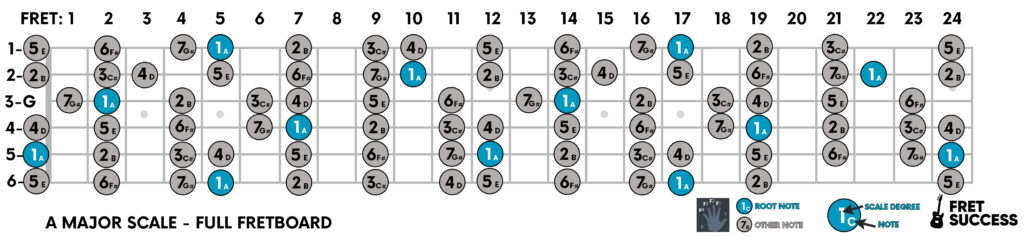
The fretboard diagram below shows the full A major scale across all positions so you’re not stuck in one box wondering where to go next.
If you want a slightly darker, more emotive feel, lean into C# natural minor. It uses exactly the same notes as A major but the centre of gravity shifts, and so does the mood. Try starting and resolving your phrases on C# instead of A and hear what happens. Same scale, completely different emotional weight.
A Major Fretboard Diagram
Soloing over this track
Understanding the scale on the neck
Most players start with one box position and stay there. The goal with this track is to start connecting positions so you’re moving freely across the neck rather than pacing the same small cage.
The A major scale has five main positions across the fretboard. Start by finding the root note A on each string and use those as anchor points to navigate between positions. A good starting point is position 2, which sits around the 4th to 7th fret area and gives you a comfortable range to work with on this style of track.
Three ideas to get you started
Idea 1. The A major pull-off phrase
A simple but effective phrase that sits in position 2 around the 4th fret.
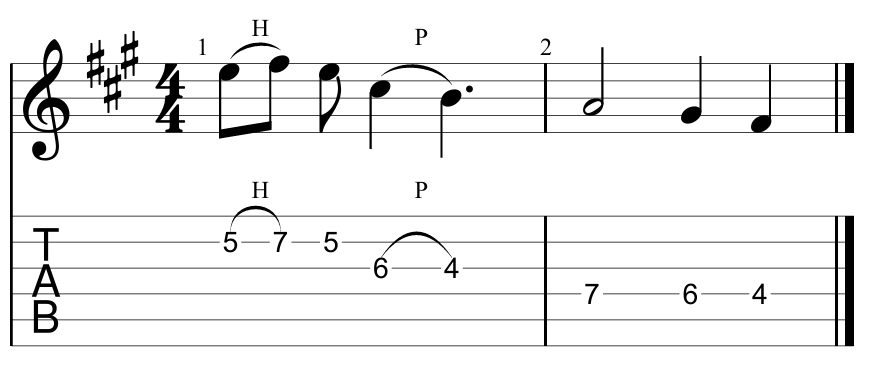
Start on the B string, hammer on from the 5th to 7th fret, then descend down through the scale resolving to A on the D string. The hammer-on gives it momentum and the descending line feels natural over the A chord.
Idea 2. The F#m minor feel phrase
When the chord moves to F#m, lean into that minor feel by targeting F# and A as your key notes.
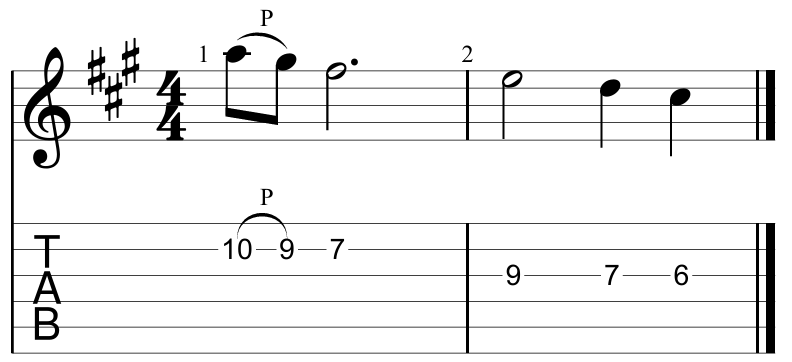
This sits higher up the neck around the 9th fret area. The phrase descends from the high B string into the G string landing. It has a slightly darker, more emotive quality that suits the F#m chord well.
Idea 3. A simple bending phrase
Bends are where the A major scale starts to sound like real guitar playing rather than a scale exercise.
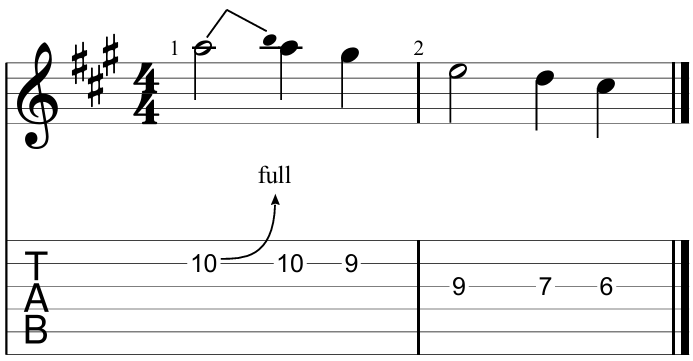
Bend the B string at the 10th fret up a full tone. Release it, descend through the B and G strings. That bend into the second note of A Major is a sound you’ll recognize from a lot of melodic rock playing.
Phrasing tips
The biggest difference between players who sound musical and players who sound like they’re practising is space. Leave gaps. Let notes breathe. A three-note phrase with silence after it will almost always sound better than eight notes crammed into the same space.
Try this: play a short phrase, stop, listen to the chord underneath, then respond to it. Think of it as a conversation with the track rather than a performance over it.
Pay attention to where you land. Ending a phrase on A, C#, or E will feel resolved and settled. Ending on F# or D will feel slightly open, like a question. Use that contrast deliberately.
Don’t just noodle. Pick a position, find a phrase you like, repeat it, develop it, move it. The goal is to sound musical, not just to hit the right notes.
Join the Fret Success list
Practical guitar content. No fluff.
Direct to your inbox.
Here’s a video of my jamming over the track for some inspiration